Two lectureships in Botany at Gothenburg University

The Department of Biology and Environmental Science at Gothenburg University invites applicants to two Botany lectureships, one specializing in Vascular Plant Systematics, the other in Systematics of non-vascular Plants and other Cryptogams. Each of the positions include 40% curational tasks at Herbarium GB. For more information and how to apply, see links below:

Göteborgs universitet | Senior Lecturer in Botany specialising in vascular plant systematics

Göteborgs universitet | Senior lecturer in Botany specialising in systematics of non-vascular plants and other cryptogams

2-year postdoc in phylogenomics and evolution of fire adaptations in Malagasy Erica

The Department of Ecology, Environment and Plant Sciences (DEEP) at Stockholm University is inviting applications for a postdoctoral researcher in phylogenomics and evolution of fire adaptations in Malagasy Erica. Situated in Sweden’s dynamic capital, the university offers a world-class research environment where education and research thrive together.

For more information and how to apply, see: https://www.su.se/english/divisions/department-of-ecology-environment-and-plant-sciences/news/articles/2025-12-18-2-year-postdoc-in-phylogenomics-and-evolution-of-fire-adaptations-in-malagasy–erica

Application deadline: 30 Jan 2026. Questions? Contact Jan Hackel .

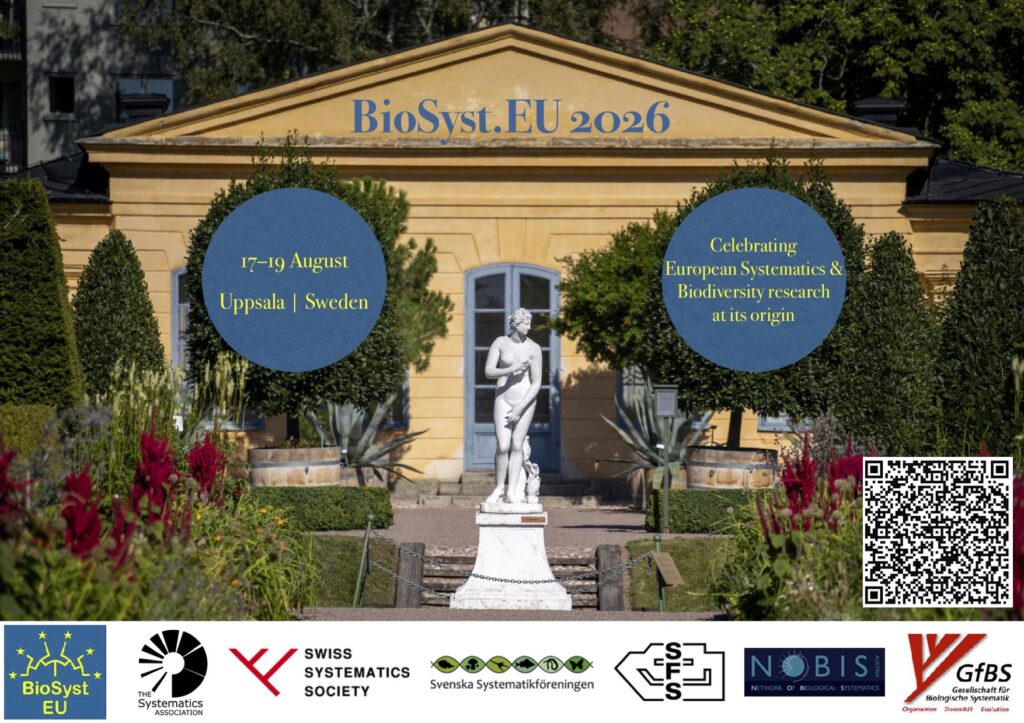
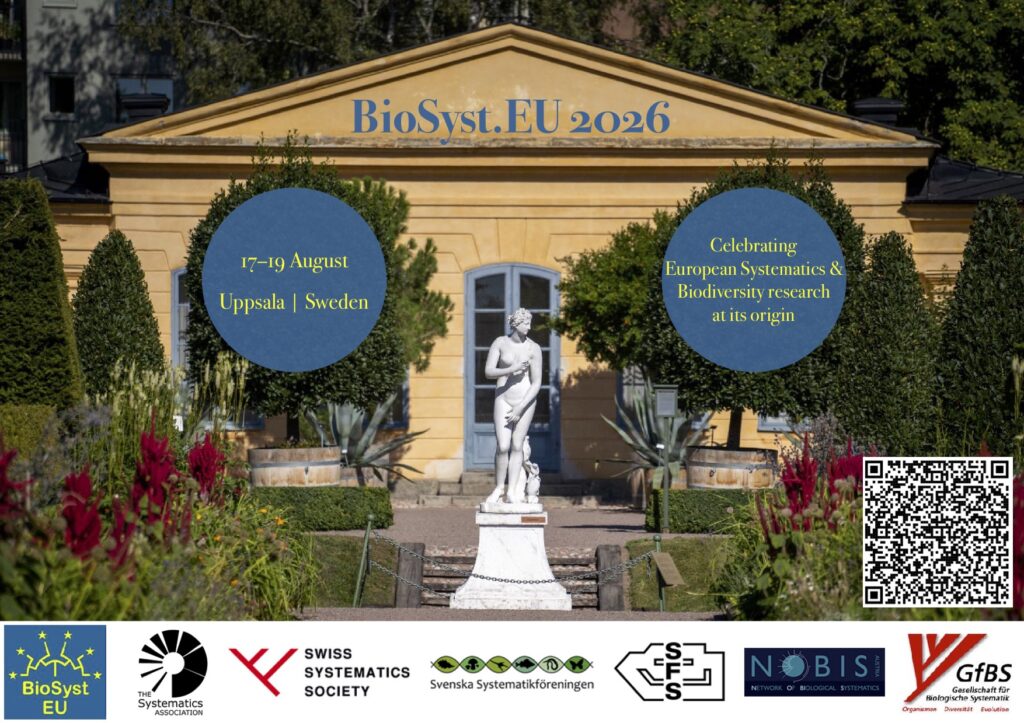
BioSyst.EU 2026

We are delighted to confirm that the 4th European Systematics meeting (BioSyst.EU) will be held in Uppsala, Sweden, 17–19 August 2026. The meeting is hosted by Uppsala University and the Swedish Systematics Society, in partnership with the Swiss, German, Austrian, French and UK societies, as well as the Swedish Species Information Centre (Artdatabanken) and Wallenberg and SciLifeLab Programme for Data Driven Life Science (Evolution and Biodiversity).

More information can be found via the conference website : https://www.trippus.net/BioSyst2026 , which will be updated with further details about the programme and symposia in the coming weeks. In the meantime, feel free to share the link and distribute the attached poster. Registration will open in February 2026.

Wishing you all a peaceful end to 2025 – and looking forward to seeing you in Uppsala in August!

On behalf of the organising committee, 

Mårten Klinth, Tobias Andermann & Aelys Humphreys

Postdoctoral Fellowships at the Arnold Arboretum

The Arnold Arboretum of Harvard University invites early career scientists to apply for a unique opportunity to start a research career as independent postdoctoral fellow while gaining training and connections within the framework of a top-tier academic environment. The Katharine H. Putnam Fellowship in Plant Science supports scientists focused on utilizing the Arnold Arboretum’s living collections of woody plants to study any area of plant science. The Global Change Postdoctoral Fellowship supports researchers that tackle any area of global change science utilizing the myriad resources of the Arnold Arboretum.

See further information and how to apply here: https://arboretum.harvard.edu/research/programs-and-opportunities/postdoctoral-fellowships-at-the-arnold-arboretum/

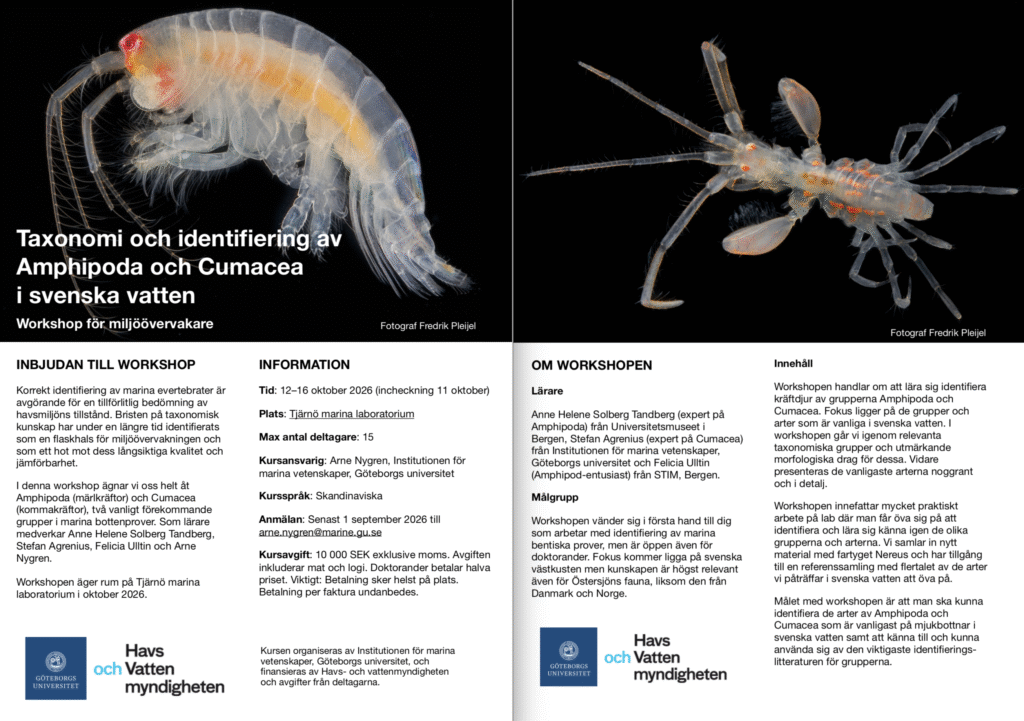
Marine Meiofauna Diversity – field course

Exploring microscopic animals that shape marine ecosystems, June 8-18, 2026 at Tjärnö Marine Laboratory on the Swedish west coast.

This course aims to give students a solid background in the systematics, taxonomy, diversity and ecology of marine meiofauna. The course will be given in conjunction with a workshop gathering an international group of 12 meiofauna researchers. The course will provide an excellent learning environment and discussion forum for advanced students of marine invertebrate taxonomy and systematics.

This Meio2 course will introduce students to the study of marine meiofauna. Fieldwork includes ship-based collection using a variety of equipment as well as littoral sampling. Laboratory exercises include extraction, isolation and identification of various meiofauna groups. Specialists will give lectures on meiofauna diversity and systematics, metabarcoding of meiofauna and other topics. Students will complete a small project during the course that will serve as the basis for the examination. 

Priority target group: PhD students, master students, postdocs, researchers. Relevant background in biology is required. Priority will be given to students working with or intending to work with aspects of meiofauna biology.

Working language: English

Course credits: content corresponds to 4 ECTS

Fee: Admission to the course includes accommodation (food and lodging) at Tjärnö from 8-18 June. These costs are covered by SLU Artdatabanken. Travel costs are not covered. There is no course fee.

Application: Open until Feb 1 2026

https://www.slu.se/en/slu-swedish-species-information-centre/about-us/sti/funding-and-research/ongoing-and-upcoming/marine-meiofauna-diversity-field-course

Questions? Contact ansokan.artprojekt@slu.se

Organizing bodies: SLU Swedish Species Information Centre and The Swedish Museum of Natural History.

ASSISTANT PROFESSOR IN NON-SEED PLANT DIVERSITY (BRYOPHYTES, FERNS, LYCOPHYTES)

Department of Botany in the Faculty of Science at the University of British Columbia, Vancouver

Position Description

The Department of Botany seeks candidates for a tenure-track Assistant Professor in the area of Non-Seed Plant Diversity with an expected start date of July 1, 2026. This is a full-time position with an expected starting salary range of $120,000 to $135,000 per annum.  Applicants conducting innovative research in the area of bryophyte, fern, or lycophyte diversity are encouraged to apply, including those who employ systematics, phylogenetics, evolution, paleobotany, ecology, cell biology, developmental biology, physiology, molecular biology, genomics, or related techniques, and whose research ideally includes the collection and use of field samples and/or museum collections to address fundamental questions on the biodiversity and comparative biology of non-seed plants.

The position requires a Ph.D. degree to be awarded before the start of the position. The successful candidate will also be expected to have postdoctoral experience and an exceptional research track record. Responsibilities include establishing and conducting an internationally competitive and externally funded research program, commitment to excellence in teaching at both the undergraduate and graduate levels, supervising graduate students, and participating in service roles that contribute to the department, university, and academic/scientific community. The successful applicant will have a strong commitment to equity, diversity, and inclusion to create a welcoming community for all, particularly those who are historically, persistently or systemically marginalized. In evaluating candidates, we will also consider evidence of leadership within the candidate’s community, and potential for developing and implementing evidence-based teaching approaches. The position includes opportunities for strong interactions with UBC’s Biodiversity Research Centre, Michael Smith Laboratories, Beaty Biodiversity Museum, UBC Botanical Garden, the Faculty of Land & Food Systems, and the Faculty of Forestry.

The UBC Department of Botany has 30 research faculty members and is one of the strongest botanical/plant-science-focused departments in North America. We offer a wide range of research and educational programs (https://www.botany.ubc.ca/). The Department of Botany embraces research, teaching, and learning at the frontiers of plant, algal, fungal, and protist biology. This organismal diversity is studied at all biological levels, from biochemical, molecular, genomic, and cellular levels, to the evolution of species and domains of life, and the ecology of populations, communities, ecosystems, through to the biosphere as a whole. The department is also home to 15 teaching faculty members who are innovative leaders in science education. The Departments of Botany and Zoology collaborate to teach the UBC Biology undergraduate program, and research and teaching faculty from both departments have a strong tradition of enhanced educational experiences that engage students in research and the scholarship of teaching and learning. Research in the department is supported by the UBC Herbarium, microscopy infrastructure in the Bioimaging Facility (BIF), the Sequencing+Bioinformatics Consortium, and departmental plant growth facilities. Botany faculty members occupy research labs located primarily in three adjacent modern research facilities: the Biosciences Building, the Michael Smith Laboratories, and the Biodiversity Research Centre.

UBC’s campuses are located on the traditional, ancestral, and unceded territories of the Syilx (Okanagan) Peoples and of the Coast Salish Peoples, including the territories of the xwməθkwəy̓əm (Musqueam), Skwxwú7mesh (Squamish), and Stó:lō and Səl̓ílwətaʔ/Selilwitulh (Tsleil Waututh) Nations.

Applicants must submit via Academic Jobs Online:

https://academicjobsonline.org/ajo/jobs/31140

1. Cover letter (1 page maximum) that summarizes:

• Your research vision and accomplishments

• How your expertise, scholarship, and planned research will integrate with the Department of Botany

• How you have displayed leadership through existing or proposed research, teaching, service, student training and mentoring, community engagement, outreach contributions to equity, diversity, and inclusion, or other relevant activities

2. Curriculum vitae, including a list of publications

3. Research statement (up to 3 pages maximum) describing your current and proposed research program

4. Teaching statement (1 page maximum) describing teaching philosophy/interests and accomplishments, addressing how you will teach core undergraduate courses in the UBC Biology program, and how you would mentor graduate and undergraduate students in research

5. Diversity statement (1 page maximum) describing your lived background experience (if comfortable stating this) and your past experience and future plans to work with a diverse student body and contribute to a culture of equity and inclusion. When preparing the statement, applicants are encouraged to familiarize themselves with UBC EDI mandates and resources (https://equity.ubc.ca/).

6. Up to three representative publications in PDF format

7. Names and contact information for three referees

Applications must be addressed to Botany Head Shawn Mansfield and submitted via Academic Jobs Online https://academicjobsonline.org/ajo/jobs/31140. The closing date for applications is December 19, 2025 at 5pm (Pacific Standard Time).

Additional Information:

 UBC hires on the basis of merit and is committed to employment equity. Equity and diversity are essential to academic excellence.  An open and diverse community fosters the inclusion of voices that have been underrepresented or discouraged.  Inclusion is built by individual and institutional responsibility through continuous engagement with diversity to inspire people, ideas, and actions for a better world. We encourage applications from members of groups that have been marginalized on any grounds enumerated under the B.C. Human Rights Code, including sex, sexual orientation, gender identity or expression, racialization, disability, political belief, religion, marital or family status, age, and/or status as a First Nation, Métis, Inuk, or Indigenous person. UBC acknowledges that certain circumstances may cause career interruptions that legitimately affect an applicant’s record of research or educational leadership achievement. We encourage applicants to note in their applications whether they would like consideration given to the impact of any circumstances, such as those due to health or family reasons, in order to allow for a fair assessment of their research productivity. All qualified candidates are encouraged to apply; however Canadian citizens and permanent residents will be given priority, and members of historically marginalized groups will be given special consideration.

If you have any needs or questions regarding accommodations or accessibility during the job application, recruitment and hiring process or for more information and support, please visit UBC’s Center For Workplace Accessibility website at https://hr.ubc.ca/health-and-wellbeing/working-injury-illness-or-disability/centre-workplace-accessibility or contact the Centre at workplace.accessibility@ubc.ca.

The University is committed to creating and maintaining an accessible work environment for all members of its workforce. Within this hiring process we will make efforts to create an accessible process for all candidates (including but not limited to disabled people). Confidential accommodations are available on request by contacting Jenifer D’souza, Faculty HR Manager at jenifer.dsouza@botany.ubc.ca.

Kallelse till årsmöte med Svenska systematikföreningen/Invitation to the Annual General Meeting of the Swedish Systematics Association

Tidpunkt och plats

Måndag 24 november 2025 klockan 16:00, Naturhistoriska riksmuseet, Frescativägen 40, Stockholm. Årsmötet hålls i samband med Systematikdagarna 2025.

Dagordning

  1. Mötet öppnas
  2. Val av mötesordförande, mötessekreterare och två justeringspersoner
  3. Fråga om mötet blivit i behörig ordning utlyst
  4. Styrelsens årsberättelse inklusive ekonomisk berättelse
  5. Revisionsberättelse
  6. Fråga om ansvarsfrihet för styrelsen för föregående års förvaltning
  7. Ändring av föreningens stadgar för att inkludera en 4:e medlem i valberedningen (första omröstningen).
  8. Val av ordförande för föreningen
  9. Val av övriga styrelseledamöter
  10. Val av en revisor och en revisorssuppleant
  11. Val av valberedning på tre personer
  12. Fastställande av eventuell årsavgift
  13. Ärenden, som styrelsen förelägger årsmötet
  14. Övriga frågor som med motivering inkommit till styrelsen senast fyra veckor innan årsmötet
  15. Mötet avslutas

Passa också gärna på att bli medlem, för att stödja föreningen! Avgiften för 2025/2026 är 100 kr (gratis för grundutbildningsstudenter).

Väl mött!

Styrelsen

Invitation to the Annual General Meeting of the Swedish Systematics Association

Date and place

Monday 24 November 2025 at 16:00, Swedish Museum of Natural History, Frescativägen 40, Stockholm. The meeting will take place during Systematikdagarna 2025.

Agenda:

  1. Meeting opens
  2. Election of meeting chair, meeting secretary and two attestors
  3. Question: has the meeting been advertised according to the statutes
  4. The board’s yearly report, including financial report
  5. Auditor’s report
  6. Question about discharge of liability for the board for the previous year’s administration
  7. Changes to the associations statues to allow a 4th member in the nomination committee (first time voting)
  8. Election of chairman of the association
  9. Election of other members of the board
  10. Election of one auditor and one deputy auditor
  11. Election of nomination committee consisting of 3 persons
  12. Decision on annual membership fee (if any)
  13. Other matters which the board submits to the meeting
  14. Other matters submitted to the board at least 4 weeks prior to the meeting
  15. Meeting ends

You are very welcome to become a member to support the association! The fee for 2025/2026 is 100 SEK (free for nongraduate students).

Welcome!

The board

Registration for Systematikdagarna 2025 has opened

You can now register for Systematikdagarna 24-25 November 2025 in Stockholm.

The meeting is open for anyone interested in systematics; amateurs, working systematists, and users of systematics in any form. The conference includes a social programme on Monday evening with glögg mixer and dinner. Prizes will be awarded to best student talk and poster. The day before the conference a meeting for early career researchers will be held at Stockholm University.

More information and registration

Welcome!

27th YOUNG SYSTEMATISTS’ FORUM

Friday 14th November 2022, 9:30 am GMT

ZOOM Online

The annual Young Systematists’ Forum represents an exciting setting
for Master’s students, PhD students and young postdoctoral researchers
to present their work, often for the first time, to a scientific
audience interested in taxonomy and systematics. This well-established
event provides an important opportunity for budding systematists to
discuss their research in front of their peers within a supportive
environment. Supervisors and other established systematists are also
encouraged to attend.

Prizes will be awarded for the most promising talk and flash
presentation as judged by a small panel on the day.

Registration is FREE.
https://systass.org/events/ysf/

When you register you will be asked to supply your name, contact
information and tell us whether you wish to give a full talk or flash
presentation. Please also tell us your academic stage – e.g., Masters,
PhD or postdoc and affiliation. Abstract submission and registration
are separate portals, both on the YSF event page.

Spaces will be allocated subject to availability and for a balanced
programme of animal, plant, algal, microbial, molecular and other
research. Non-presenting attendees are also very welcome – please register
as above.

Abstracts must be submitted by e-mail in English and in Word format
no later than Saturday 18 October 2025. The body text should not
exceed 150 words in length. Title, authors, and their professional
affiliations/addresses should be included with the abstracts. If
the presentation is co-authored, the actual speaker must be clearly
indicated in BOLD text. The file should be in editable format (.doc or
.odt, not pdf) and titled Surname_First-name_YSF2025.doc, for example
Doe_Jane_YSF2025.doc.

If you have presented a talk at the YSF before, we ask that you submit
only for a flash presentation, as speaker slots are limited and we want
to give as many people a chance as possible. If you are a postdoc, please
be aware that we might not be able to give you a chance to present here,
as the aim is to give more junior researchers their first experience in
a supportive international setting.

All registered attendants will receive further information about
the meeting, including abstracts, by e-mail one week in advance. This
information will also be displayed on the Systematics Association website
(www.systass.org).

If you have questions, feel free to contact us at ysf@systass.org

Last year’s meeting was very dynamic, with wide international
attendance and great interactions.

We’re looking forward to meeting you online!

YSF 2025 Organising Team:
Ellinor Michel, Ana Serra Silva, Kalman Konyves, Peter Mulhair,
Katie Collins, Pablo Muñoz-Rodrguez

Organised by

The Systematics Association

With additional sponsorship from:

The Natural History Museum, London, Kew Botanical Gardens, CRC Press